
Google AI Mode vs. Traditional Search: What’s the Difference?
Table of Contents:
Traditional Google Search
Google AI Mode
Comparison of Google AI Mode and Traditional Search
Technological Differences
Security and Reliability
Conclusion
FAQ
Google AI Mode vs. Traditional Search: What’s the Difference?
Is Google’s traditional search starting to feel a bit outdated? You may not be wrong! Recently, Google introduced a new type of search engine called AI Mode, as well as the differences between the two are substantial. Let’s dive into it.
Traditional Google Search
For years, Google search has been the starting point for most users online. It works by indexing websites, ranking each based on factors like relevance. When you type something into the search bar, Google returns a ranked list of website hyperlinks. Often, it includes snippets, next to thumbnails.
Traditional search is handy for quickly finding something you know, although it requires you to examine several hyperlinks to find what’s most relevant to you.
Features of Traditional Search
- Ranked List of Links – Websites are ranked by relevance to your query.
- Single-Step Queries – Searches work best with keywords or short phrases.
- Your Effort Required – High. You must dig through multiple hyperlinks.
- Data Sources – Mainly individual websites.
- Context – Limited. It doesn’t carry over as you search again.
Google AI Mode
Google AI Mode is a transformation in the search approach, using AI to get you the answer you need. Instead of a long list of ranked links, it gives you a full-page answer, piecing together info from lots of places. It’s driven by an advanced model that lets it handle involved requests and reason through intent.
AI Mode goes beyond traditional search to provide comprehensive, synthesized information. Instead of just pointing you to resources, it takes from them to get you an answer.
What are the features of Google AI Mode?
- AI-Generated Responses – Comprehensive answers given, including visuals and suggested next steps.
- Multi-Step Queries – Able to understand complicated questions.
- Data Sources – Information from several sources put together, like the Knowledge Graph, also shopping data.
- Your Effort Required – Low. You see a consolidated answer, easy to read.
- Context – Improved. It remembers what you searched before.
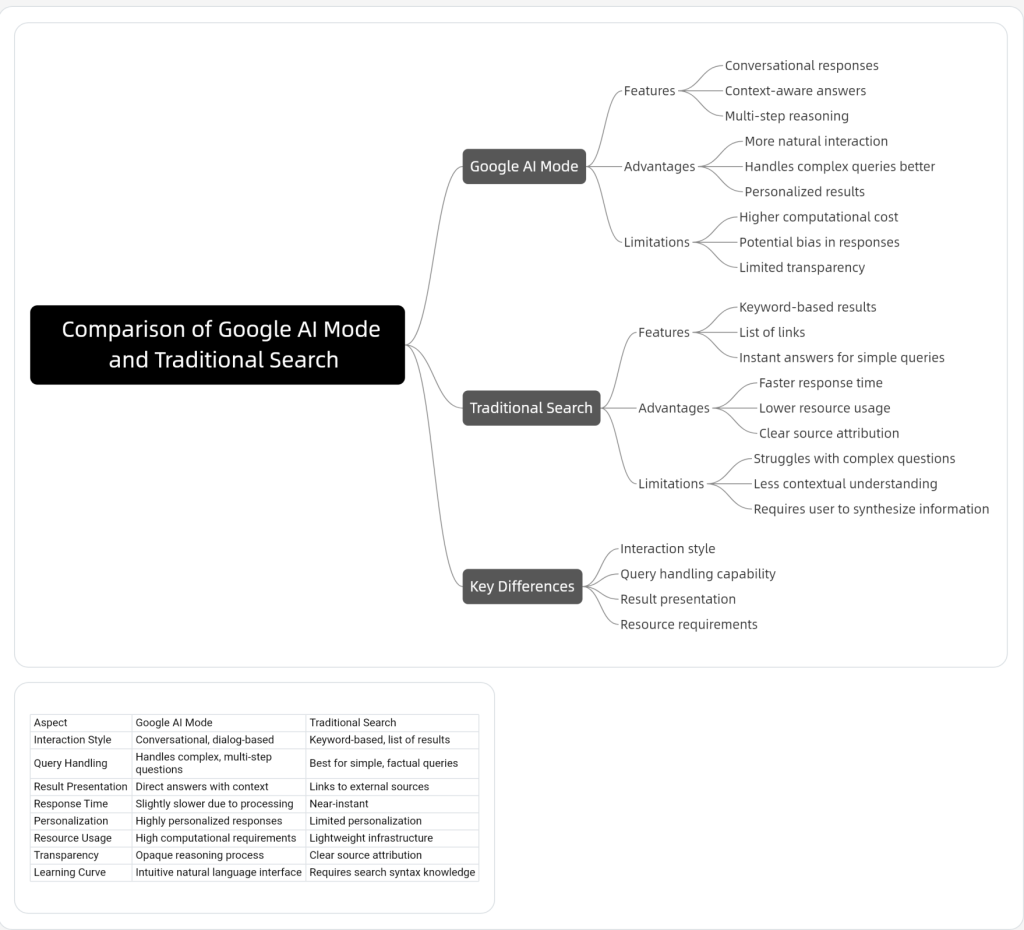
Comparison of Google AI Mode and Traditional Search
Let’s look at some key ways the two search models are different.
Response Format:
- Traditional Search – Returns links – you’re the one who must visit each site to get details.
- Google AI Mode – A page of aggregated information, offering a more complete response.
Query Handling:
- Traditional Search – Suitable for keyword based queries.
- Google AI Mode – Handles complex, intent-driven searches.
Data Sources:
- Traditional Search – Primary source of information is websites.
- Google AI Mode – Pulls from different sources. Google’s Knowledge Graph, including shopping data, gives a bigger knowledge base.
Your Effort:
- Traditional Search – You must carefully read and compare results, a task requiring your effort.
- Google AI Mode – Presents a consolidated answer.
Visual Elements:
- Traditional Search – Snippets shown and thumbnails shown.
- Google AI Mode – Lists, images, charts, along with tools help give context.
Context Retention:
- Traditional Search – Limited to no awareness.
- Google AI Mode – More context is maintained throughout complex queries.
Technological Differences
The difference between Google AI Mode and traditional search lies in technology. AI Mode uses advanced AI to understand and rearrange information. Traditional search mainly depends on indexing and ranking.
The AI’s incorporation gives better results, especially for complicated searches.
Query Fan-Out Technique
Google AI Mode uses a “query fan-out” technique. This is where it runs several searches at once across topics, as well as sources. This brings together much data that traditional search cannot.
Security and Reliability
Google AI Mode focuses on trustworthiness of generated answers. When the AI doesn’t have confidence in its response, it will show classic search results. This mechanism addresses concerns about the correctness of content.
Conclusion
Google AI Mode is a step forward in search. The old search way is better for some uses, but AI Mode works better for complicated comparison shopping, so the user expends less effort. With constant AI improvements, the AI Mode will grow further.
FAQ
What if I don’t like the AI results?
In cases where the AI is uncertain or lacks sufficient confidence in its response, it reverts to displaying classic search results. You can also use regular Google search if you prefer the standard search results.
Is the AI Mode always more accurate?
Not necessarily. Google AI Mode is designed to provide comprehensive answers, but it aggregates information from different sources. Always verify information, especially if it is on a critical topic.
Resources & References:
- https://www.collectivemeasures.com/insights/how-google-ai-mode-shifts-the-search-experience
- https://www.vktr.com/ai-technology/googles-ai-mode-signals-a-new-era-in-search/
- https://www.matthewedgar.net/generative-ai-vs-traditional-search-technical-differences/
- https://blog.google/products/search/ai-mode-search/
- https://xpert.digital/en/google-ai-mode/